
Hyvä Theme SEO: How It Transforms Adobe Commerce Performance
Originally published October 2024. Fully rewritten and updated February 2026.
If you’re running an Adobe Commerce store on the default Luma theme and wondering why your Core Web Vitals look like a crime scene, you’re not alone. Luma was built in an era when loading 230 requests and 3MB of uncompressed assets per page was considered acceptable. It’s not anymore, and Google’s ranking algorithm has been making that clear for years.
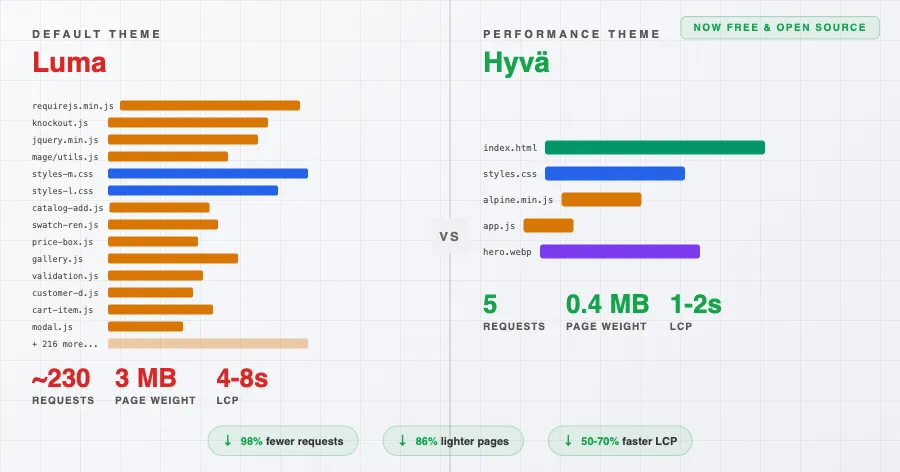
Hyvä changes the equation entirely. It’s a modern, performance-first frontend theme for Adobe Commerce (Mage-OS) that replaces Luma’s bloated RequireJS and KnockoutJS stack with Alpine.js and Tailwind CSS. The result: 5 page requests instead of 230, 0.4MB instead of 3MB, and Core Web Vitals scores that actually pass Google’s thresholds.
And as of November 2025, Hyvä Theme is fully open source and free, licensed under OSL3 + AFL3, the same license as Magento Open Source itself. The barrier to entry that once existed is gone.
Here’s what that means for your store’s SEO.
How Much Faster Is Hyvä Than Luma?
The performance gap between Hyvä and Luma isn’t marginal. It’s dramatic. Based on Hyvä’s published benchmarks and what we’ve seen across our own migrations:
| Metric | Luma (Default) | Hyvä | Improvement |
|---|---|---|---|
| Page Requests | ~230 | ~5 | 98% reduction |
| Page Weight (uncompressed) | ~3MB | ~0.4MB | 86% reduction |
| JavaScript Payload | Heavy (RequireJS waterfall) | Minimal (Alpine.js inline) | ~90% reduction |
| Typical LCP | 4-8 seconds | 1-2.5 seconds | 50-70% faster |
| Development Time | Baseline | 20-50% less | Significant savings |
These aren’t theoretical numbers. The JavaScript architecture is fundamentally different. Luma uses RequireJS, which creates a waterfall effect: the browser has to parse each JS file, figure out its dependencies, then load those, and so on. HTTP/2 doesn’t solve this because the bottleneck is sequential parsing, not parallel downloads. Hyvä sidesteps the problem entirely by using Alpine.js with inline directives and minimal external JS files.
Does Hyvä Improve Core Web Vitals?
Yes, and this is where the SEO impact gets concrete. Google uses three Core Web Vitals metrics as ranking signals, and Hyvä’s architecture directly improves all three.
Largest Contentful Paint (LCP) measures how fast your main content loads. Google’s threshold is under 2.5 seconds. Luma stores routinely fail this because the main content can’t render until the JS waterfall resolves. Hyvä’s server-rendered HTML with minimal JS means the largest element (usually a product image or hero banner) paints almost immediately.
Interaction to Next Paint (INP) measures how quickly the page responds when someone clicks, taps, or types. Luma’s heavy KnockoutJS layer adds input latency that users can feel. Hyvä’s lightweight Alpine.js handles interactions with near-zero overhead.
Cumulative Layout Shift (CLS) measures visual stability: whether elements jump around as the page loads. Hyvä’s Tailwind CSS generates only the styles actually used on each page, eliminating the render-blocking CSS bundles that cause layout shifts in Luma.
The downstream SEO effects compound: faster pages mean lower bounce rates, longer session durations, and higher crawl efficiency. When Googlebot can render your pages faster, it can crawl more of your catalog in the same crawl budget.
What Makes Hyvä’s Architecture Different?
The technical architecture is worth understanding because it explains why the performance gains are so consistent. It’s not optimization tricks, it’s a fundamentally different approach.
Luma’s stack: RequireJS (module loading) + KnockoutJS (UI binding) + jQuery + LESS CSS preprocessing. This combination produces hundreds of HTTP requests, sequential JS parsing, and large CSS bundles regardless of what the page actually needs.
Hyvä’s stack: Alpine.js (lightweight reactivity, ~15KB) + Tailwind CSS (utility-first, only ships used classes) + vanilla JavaScript where needed. Templates are PHP-based (similar to Magento 1’s simplicity), styled with Tailwind utility classes, with Alpine.js handling interactivity directly in the markup.
For SEO specifically, this means cleaner HTML output. Search engines can parse the content without waiting for JS rendering. Structured data is easier to implement cleanly. And the reduced server load means faster Time to First Byte (TTFB), which benefits both user experience and crawl efficiency.
Is Hyvä Theme Free?
Yes. Since November 10, 2025, Hyvä Theme is fully free and open source. You can download it from GitHub or get Composer keys through the Hyvä Portal at hyva.io. Each account gets up to 5 free license keys, or 50 per agency partner group.
The open-source release covers the core theme and all supporting compatibility modules. Hyvä’s premium products remain commercial products under separate licenses: Hyvä Checkout (a React-based checkout experience), Hyvä Enterprise (full Adobe Commerce compatibility), and Hyvä Commerce (enhanced admin functionality).
This matters for SEO planning because it eliminates the licensing cost that previously made Hyvä a harder sell for smaller merchants. The performance and SEO benefits are now accessible to every Adobe Commerce store, regardless of budget.
How Does Hyvä Handle Structured Data and Schema Markup?
Structured data is where many Adobe Commerce stores leave SEO value on the table. Rich snippets (product ratings, price, availability, product images) directly influence click-through rates from search results.
Hyvä ships with clean, semantic HTML5 markup that makes structured data implementation straightforward. Product schema including ratings, pricing, and stock status works out of the box. The simplified template structure (no UI component abstraction layer) means custom schema additions are easier to implement and maintain compared to Luma, where the template/block/UI component chain adds unnecessary complexity.
For stores targeting AI answer engine visibility (ChatGPT, Perplexity, Google AI Overviews), clean structured data is especially important. It’s one of the primary signals these systems use to extract and cite product information.
What About Mobile SEO?
Google’s mobile-first indexing means your mobile experience is your SEO experience. Hyvä was built mobile-first from day one, using Tailwind CSS’s responsive utility classes to handle all breakpoints.
The performance gap between Hyvä and Luma is actually wider on mobile. Luma’s heavy JS payload hits harder on slower mobile connections and less powerful processors. Hyvä’s minimal footprint means mobile pages load fast even on 3G connections, which is exactly the scenario Google simulates in its Lighthouse audits.
Hyvä Checkout claims 13x faster mobile load times compared to the standard Magento checkout, which directly impacts the conversion funnel where mobile performance matters most.
Does Switching to Hyvä Guarantee Better Rankings?
No theme guarantees rankings. SEO is a system, not a single variable. But Hyvä removes one of the biggest technical obstacles Adobe Commerce stores face: the performance floor imposed by Luma’s architecture.
Think of it this way: Luma creates a performance ceiling that’s hard to break through regardless of how much optimization you do. You can minify, bundle, defer, and lazy-load your way to marginal improvements, but you’re still fighting the fundamental architecture. Hyvä raises that ceiling dramatically, giving your content, backlink, and conversion optimization efforts room to actually move the needle.
The stores where we’ve seen the biggest SEO impact from Hyvä migrations are the ones that also invested in content strategy, technical SEO hygiene, and structured data alongside the theme change. The theme provides the foundation. What you build on it determines the results.
Frequently Asked Questions
How long does a Luma to Hyvä migration take?
It depends on store complexity, but the community consensus is that Hyvä builds take roughly one-third the development time of equivalent Luma builds. A straightforward migration might take 3-4 weeks with dedicated developers, compared to months for a Luma rebuild.
Will my existing extensions work with Hyvä?
Not all of them, out of the box. Because Hyvä uses Alpine.js and Tailwind instead of KnockoutJS and LESS, extensions with frontend components need Hyvä-compatible templates. The Hyvä ecosystem has grown significantly. Many major extension vendors now offer Hyvä compatibility modules, and the list continues to expand since the open-source release.
Is Hyvä compatible with Adobe Commerce Cloud?
Yes. Hyvä Enterprise provides full Adobe Commerce compatibility, including B2B features and other Commerce-specific functionality. The free open-source theme works with Magento Open Source and can be extended for Commerce environments.
What’s the SEO risk of migrating from Luma to Hyvä?
URL structure and content don’t change during a theme migration. Hyvä replaces the frontend presentation layer, not the catalog or URL routing. The primary risk is the same as any redesign: ensuring redirects are in place if any URLs change, and monitoring rankings during the transition period. In practice, most stores see ranking improvements within weeks due to the performance gains.
Does Hyvä support PWA or headless?
Hyvä is a server-side rendered theme, not a headless/PWA solution. This is actually an SEO advantage: server-rendered content is immediately available to search engines without requiring JavaScript execution, which means faster and more reliable indexing.
At Rocket Web, we’re a Hyvä Silver Partner with hands-on experience migrating Adobe Commerce stores from Luma to Hyvä. If you want to talk about what a Hyvä implementation could look like for your store, get in touch.